


Recommended Blogs

Blog
Building a Cloud Center of Excellence That Drives Innovation
Table of Content
- Why Organizations Struggle to Realize Cloud Value
- Building a Cloud Center of Excellence That Enables Faster Decisions
- How a CCoE Turns Cloud Adoption into Sustainable Innovation
- Capabilities That Define a High-Impact Cloud Center of Excellence
- How TxMinds Helps Organizations Build and Scale CCoEs That Work
- Conclusion
Share On


Many enterprises now report having a Cloud Center of Excellence or central cloud function, yet far fewer describe their cloud governance, cost controls, and operating models as mature. The result is a growing gap between cloud adoption and sustainable business value.
But “being on cloud” doesn’t give you value. Repeatability is what makes a cloud transition successful instead of a costly migration. By replicating patterns that have worked in the past, making decisions within clear limits, and linking cloud spending to business results, teams can ship faster.
Key Takeaways
- Cloud value comes from maturity, not adoption: Many orgs are “on cloud,” but governance, cost control, and operating models often lag, creating a value gap.
- Repeatability is the difference-maker: Reusable patterns, clear guardrails, and spend-to-outcome visibility turn migration into scalable delivery.
- High-impact CCoEs enable, not gatekeep: They automate security/FinOps guardrails and ship “golden paths”, so teams move fast with confidence.
- Innovation becomes sustainable with structure: Sandboxes, cost caps, and a clear pilot-to-production path let teams experiment safely and scale what works.
Why Organizations Struggle to Realize Cloud Value
Most businesses move to the cloud for speed, size, and access to contemporary services, but long-term value stops because of structural issues:
- Siloed adoption creates fragmented architectures and duplicate tooling.
- No shared decision framework leads to inconsistent security, resilience, and cost choices.
- Spend grows faster than visibility when ownership, tagging, and allocation are weak.
- Security arrives late, causing rework, approval delays, and higher risk.
- Operating models don’t change, so cloud-native delivery clashes with legacy processes and skills.
A high-impact CCoE fixes this by providing teams with explicit guardrails and reusable patterns that let them work quickly without increasing risk or cost.
Building a Cloud Center of Excellence That Enables Faster Decisions
A Cloud Center of Excellence (CCoE) is a framework for aligning people, processes, and technology to accelerate responsible cloud adoption. The finest CCoEs don’t keep people out; they help them get in. They automate guardrails (security, compliance, cost) and deliver reusable building blocks (landing zones, templates, golden routes) so product teams can deliver quickly and with confidence.
You need to do things in the correct order to set up a cloud center of excellence that really speeds things up rather than slows them down.
- Define the mission: speed, cost control, compliance, and innovation—measured with clear outcomes.
- Form cross-functional core: architecture, security, platform/ops, finance (FinOps), and engineering.
- Clarify decision rights: CCoE sets guardrails; product teams deliver within them; exceptions follow a fast, defined path.
- Ship reusable patterns: landing zones, IaC templates, CI/CD “golden paths,” and lightweight runbooks.
- Track outcomes: delivery speed, reliability, spend allocation, and compliance-by-default.
This is the most important thing to do to get a cloud center of excellence that helps everyone in your business make decisions fast and with confidence.
How a CCoE Turns Cloud Adoption into Sustainable Innovation
A CCoE helps new ideas grow when it changes how teams learn, test, and get stronger at new abilities instead of just making rules and frameworks.

1. Focus On Reusable Platforms And Building Blocks
A high-impact CCoE provides shared platform components, including serverless templates, secure network designs, and CI/CD pipelines that everyone can use. This strategy avoids creating separate cloud patterns for each job.
2. Shift-left Quality, Security, And Compliance
Adding security and compliance early in the development process speeds up delivery and reduces the need to redo work. This method is at the center of the DevSecOps and FinOps sectors.
3. Bridge Business Needs With Cloud Capability
A cloud CoE for innovation not only speeds up IT, but it also connects cloud results to business benefits, such as faster feature releases, more money coming in, better customer experiences, and data-driven decisions.
4. Support Experimentation
Use sandbox environments, cost caps/quotas, and a clear path from pilot to production (what gets standardized and what gets decommissioned) to encourage new ideas. With guardrails and self-service patterns, teams can try out new services (ML, event-driven, streaming) without risking stability or compliance.
Cloud computing is more than simply a way to save money; it’s a long-lasting tool for generating new ideas that gives you an edge over your competitors.
Capabilities That Define a High-Impact Cloud Center of Excellence
CCoEs are not all the same. The difference is in the skills needed to get things done and the results.
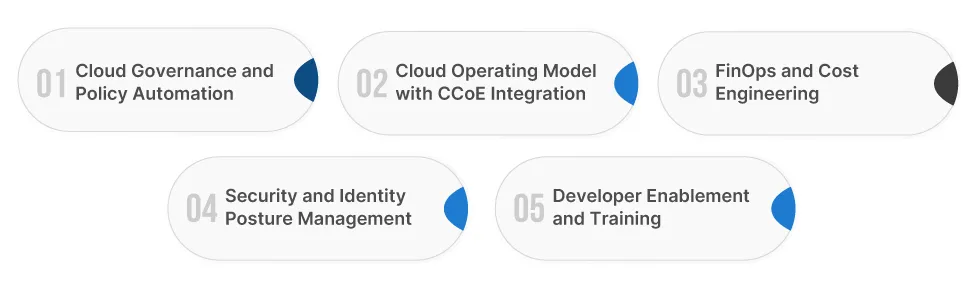
1. Cloud Governance and Policy Automation
Instead of doing things manually, automate rule enforcement. This includes cost controls, automated compliance checks, and restrictions on who can get in.
2. Cloud Operating Model with CCoE Integration
The operating model offers people ownership, establishes mechanisms for solving problems, and connects the CCoE to key project delivery lifecycles.
3. FinOps and Cost Engineering
Cost reporting, budgeting, detecting problems, and suggesting ways to improve are all critical for keeping cloud expenses down while still letting people try new things.
4. Security and Identity Posture Management
Secure defaults, identity governance, and ongoing monitoring lower risk and speed up the building of secure clouds.
5. Developer Enablement and Training
Teams will know how to use cloud services well if they keep learning new skills and choose the right cloud learning routes.
A high-impact CCoE is not static. It changes depending on feedback loops, how people actually use it, and the company’s changing aims.
How TxMinds Helps Organizations Build and Scale CCoEs That Work
Setting up a cloud center of excellence, making a functional framework, and keeping innovation going all takes time and effort.
TxMinds offers Cloud Consulting Services with an emphasis on getting results that help businesses:
- Create a practical CCoE roadmap to transform your business’s cloud.
- Make a cloud center of excellence strategy and plan that works for your business.
- Set up rules and procedures that encourage new ideas instead of stopping them.
- Get cloud teams to work together on platforms, visibility, and accountability that they all share.
- Teach teams how to use cloud-native best practices and automation.
Cloud transformation is achievable if you work with experts who know both the technology and how your business operates. This way, you can use the cloud not only for storage but also as a source of fresh ideas at all times.
Conclusion
A Cloud Center of Excellence is not a group of people or a bunch of papers. If done effectively, it speeds up delivery by giving teams reusable platforms, automatic guardrails, and unambiguous decision rights that help them ship faster while staying safe and mindful of costs. The result is cloud delivery and innovation that can be repeated, and that grows beyond the first wave of migration.
TxMinds’ Cloud Consulting Services will help you create the operating model, set up the basics, and make sure that teams continuously use cloud-native practices if you’re ready to go from ad hoc cloud adoption to a CCoE that gives you measurable results.


Vivek Gupta
VP, Delivery, Digital Engineering
Vivek Gupta is the Vice President of Delivery at Tx with over 25 years of experience driving digital transformation. At Tx, he has built the foundation for DevOps, Digital, and Cloud practices, shaping strategies that empower businesses. Before joining Tx, Vivek held leadership roles at Infosys and Tech Mahindra. His leadership fuels innovation, strengthens delivery excellence, and enhances Tx's global impact. Vivek's commitment to driving change ensures our clients stay ahead in an evolving digital landscape.
FAQs
What is the function of a cloud center of excellence?
The function of a cloud center of excellence is to guide cloud adoption through shared governance, standards, and best practices. It aligns cloud initiatives with business goals while enabling teams to innovate faster and operate securely.
Which of the 7 benefits of cloud computing is the most important?
Agility is the most important benefit of cloud computing. It allows organizations to scale resources quickly, experiment safely, and deliver new capabilities faster. This makes innovation continuous rather than episodic.
What are the 5 essentials of cloud computing?
- On-demand self-service
- Broad network access
- Resource pooling
- Rapid elasticity and scalability
- Measured service with cost transparency
Which statement best describes the purpose of a cloud center of excellence?
A cloud center of excellence exists to standardize cloud practices, reduce risk, control costs, and accelerate innovation by providing a structured yet flexible framework for enterprise-wide cloud adoption.
Discover more