For most businesses today, data is not just an asset but a critical driver of success. But for many organizations, managing and leveraging data effectively remains a major challenge. Data often sits across different systems, disconnected and hard to access, leaving decision-makers with incomplete or outdated information.
This “data chaos” slows down decision-making, stifles innovation, and creates inefficiencies that directly impact the bottom line.
As a leader, the question is not just about handling data but about making it work for your business. A modern data platform is the key to turning this chaos into opportunity. It consolidates data from multiple sources, making it accessible and actionable in real time. With the right platform, your organization can make faster, more informed decisions, optimize operations, and uncover new avenues for growth.
In this blog, we will explore how cloud data platforms are essential for transforming your data into a competitive advantage, driving business growth, and ensuring you stay ahead of the curve in today’s fast-paced market.
Key Takeaways
Modern cloud data platforms unify disparate data sources for real-time access, eliminating chaos and speeding decisions.
Cloud platforms boost agility, scalability without hardware, cost savings, and faster insights.
AI enables predictive analytics, segmentation, anomaly detection, and automation for proactive growth.
Understanding the Modern Cloud Data Platform: Key Components and Benefits
A modern data platform integrates various tools and technologies to collect, process, and analyze data in real time. It provides businesses with a unified environment to manage data, ensuring accessibility, security, and scalability. The platform combines cloud architecture, data integration, and advanced analytics to drive business intelligence and decision-making.
Key Components of Modern Data Platform:
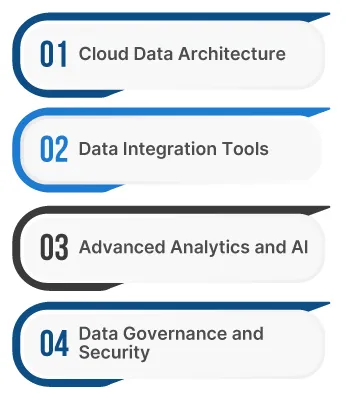
Cloud Data Architecture: The cloud provides flexibility and scalability that on-premises infrastructure cannot match. With cloud data platforms, businesses can manage large datasets without worrying about hardware limitations or maintenance costs. The cloud also ensures that data is accessible from anywhere, at any time.
Data Integration Tools: Data often resides in different systems across an organization, from CRM software to supply chain management tools. A modern data platform integrates data from various sources, ensuring it is consistent, accurate, and readily available.
Advanced Analytics and AI: Leveraging machine learning and AI technologies, modern data platforms offer predictive analytics, anomaly detection, and other advanced features that enable businesses to gain deeper insights and make proactive decisions.
Data Governance and Security: As data privacy concerns rise, ensuring the security and compliance of your data is paramount. Modern platforms provide strong governance tools to enforce data security policies, ensure compliance with regulations, and protect sensitive information.
Benefits of Modern Data Platform:
Improved Decision-Making: By providing a unified view of data, modern platforms allow businesses to make more informed decisions quickly, improving agility and responsiveness.
Scalability: With cloud-based infrastructure, organizations can easily scale their data resources up or down based on their needs, supporting growth without the constraints of traditional systems.
Cost Efficiency: Cloud-based platforms often eliminate the need for large on-premises hardware investments, offering a more cost-effective solution for businesses to manage and analyze their data.
Faster Time to Insights: A modern data platform enables faster data processing and analysis, which means businesses can act on insights more quickly, gaining a competitive advantage.
Building a Scalable Data Architecture: The Foundation of Business Intelligence
Scalable data architecture forms the foundation for building an efficient, data-driven business. The architecture must be designed to handle growing data volumes while ensuring high performance and reliability.
Here’s how to build a scalable data architecture in stages:
Data Collection: The first stage involves collecting data from various sources across the business. This could include internal systems, customer databases, social media, sensors, and third-party applications.
Data Storage: Once collected, data is stored in a centralized data lake or data warehouse. Data lakes are ideal for storing large volumes of raw, unstructured data, while data warehouses store processed, structured data that is optimized for reporting and analytics.
Data Integration: After storage, data must be integrated from different systems. Using ETL (Extract, Transform, Load) processes, businesses can standardize data from disparate sources into a common format, ensuring consistency and accessibility.
Data Processing: With data ready to be analyzed, the next stage involves processing and transforming it into actionable insights. Advanced analytics tools, such as data visualization and business intelligence platforms, can be used to make sense of the data.
Data Analysis and Reporting: At this stage, businesses can analyze the processed data, uncover trends, and generate reports. This helps stakeholders make decisions based on real-time, accurate information.
Continuous Optimization: A scalable architecture allows businesses to continuously refine their data management and analytics processes. As data needs grow, the architecture can be adjusted to accommodate new data sources, additional workloads, and emerging technologies.
By building a data architecture that can grow with the organization, businesses can avoid performance bottlenecks and ensure their platform is capable of handling future demands.
Integrating Data from Multiple Sources: Ensuring Consistency and Accessibility
Data integration is one of the most critical aspects of building a modern data platform. Businesses today operate in an environment with numerous data sources from customer relationship management (CRM) systems to cloud storage platforms, marketing automation tools, and IoT devices. Each of these sources stores data in different formats and structures, making it challenging to access and analyze the data effectively.
Modern data platforms address this challenge by using integration tools that connect disparate data systems, ensuring that all data flows into a centralized platform. This provides businesses with a unified view of their data, enhancing decision-making and reporting. Integration tools often include API connectors, ETL processes, and data pipelines that automatically cleanse and transform data into a standard format.
Moreover, ensuring data consistency is key to accurate reporting. Discrepancies in data from different sources can lead to errors and misinformed decisions. Modern platforms employ data validation rules and real-time monitoring to maintain the integrity and consistency of data across the entire organization.
With all data integrated and accessible, businesses can improve collaboration across teams and departments. Sales, marketing, and operations can all work from the same set of data, reducing confusion and ensuring that decisions are based on the most up-to-date information.
Leveraging Advanced Analytics and AI for Actionable Insights
A modern data platform doesn’t just store and manage data it also transforms it into valuable insights. By using advanced analytics and AI, businesses can uncover hidden patterns, predict future trends, and make smarter decisions.
Key Analytics and AI Capabilities:
Predictive Analytics: By analyzing historical data, businesses can predict future outcomes, such as customer behavior, market trends, and inventory needs. This allows companies to make proactive decisions and stay ahead of the competition.
Customer Segmentation: AI can help businesses identify customer segments based on purchasing behavior, preferences, and demographics. This enables personalized marketing and better targeted campaigns.
Anomaly Detection: AI models can identify outliers in data, alerting businesses to potential issues, whether it’s fraud, operational inefficiencies, or market shifts.
Automated Reporting: With machine learning, businesses can automate the generation of reports and dashboards, save time, and ensure that key stakeholders always have the most current data.
By leveraging AI and advanced analytics, organizations can move from reactive to proactive decision-making, gaining deeper insights that can drive operational efficiency, increase revenue, and enhance customer experiences.
Overcoming Challenges in Modern Data Platform Adoption
While the benefits of a modern data platform are clear, adopting such a system can present several challenges. Many enterprises still rely on legacy systems or face internal resistance to change. However, these obstacles can be overcome with careful planning and the right approach.
Challenges:
Data Silos: Disconnected data across departments can make it difficult to gain a unified view of business performance.
Employee Resistance: Transitioning to a modern data platform requires overcoming resistance from staff who are comfortable with legacy systems.
Cost and Complexity: Implementing a modern data platform can be costly and time-consuming, particularly for large enterprises.
Data Security and Compliance: Ensuring that data is secure and compliant with regulations like GDPR is a top priority for businesses handling sensitive information.
Solutions:
Centralize Data with Integration Tools: Use data integration tools to break down silos and centralize data, ensuring consistency and accessibility across the organization.
Training and Support: Offer training to help employees adapt to new technologies and ensure smooth adoption of the platform.
Data Governance and Security: Implement strong security protocols and data governance practices to ensure compliance and protect sensitive data.
By addressing these challenges head-on, businesses can successfully adopt a modern data platform and unlock its full potential for growth and innovation.
Empower Your Business with Cloud Data Engineering Services at TxMinds
At TxMinds, we specialize in providing comprehensive cloud data platform solutions that help businesses transform their data infrastructure. Our team of experts works closely with you to understand your unique needs and design a platform that seamlessly integrates your data, optimizes your analytics, and drives business intelligence.
With our scalable cloud data engineering services, we empower businesses to harness the full potential of their data. Whether you are looking to modernize your data architecture or implement advanced analytics, TxMinds has the tools and expertise to help you succeed in today’s competitive marketplace.
Amar Jamadhiar is the Vice President of Delivery for TxMind's North America region, driving innovation and strategic partnerships. With over 30 years of experience, he has played a key role in forging alliances with UiPath, Tricentis, AccelQ, and others. His expertise helps Tx explore AI, ML, and data engineering advancements.
FAQs
What is a cloud data platform?
A cloud data platform unifies data collection, storage, processing, and analytics in a scalable cloud environment, providing real-time access and eliminating data silos for faster business intelligence.
How does a modern data platform benefit business intelligence?
Modern data platforms for business intelligence integrate diverse sources via ETL tools, leverage AI for predictive insights, and ensure data consistency, enabling quicker decisions and competitive growth.
What does cloud data platform modernization involve?
Cloud data platform modernization entails transitioning from legacy systems to scalable architectures like data lakes or lakehouses, incorporating governance, security, and advanced analytics for enterprise data platforms for BI efficiency.
What is the CIO blueprint for a cloud data platform?
The CIO blueprint for a cloud data platform outline building scalable data architecture through collection from CRM/IoT, integration, AI-driven analytics, and overcoming silos with training and cloud data engineering services for BI.