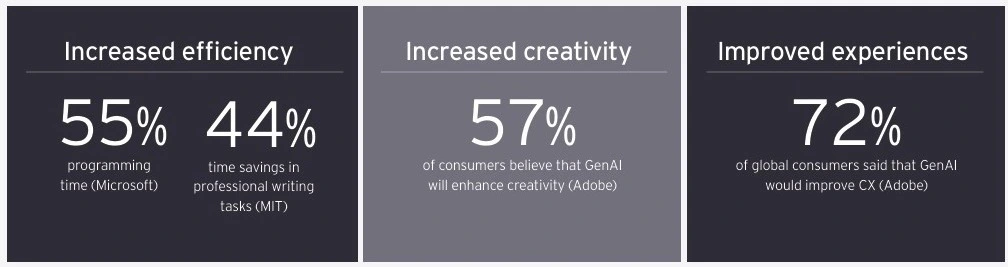
Did you know that 67% of enterprises are increasing their investment in GenAI?
This statistic highlights the growing confidence businesses have in generative AI and its transformative potential. As more organizations explore how to integrate generative AI into business applications, a clear, structured approach is essential for successful adoption.
Generative AI offers businesses the chance to innovate, automate complex processes, and improve decision-making. However, unlocking its full potential requires a carefully planned strategy to ensure smooth integration and scalability.
In this blog, our experts will break down the key steps necessary for integrating generative AI in business applications and ensuring long-term success.
Key Takeaways
67% of enterprises are increasing their investment in GenAI, which shows adoption is accelerating.
Teams should focus on the highest-impact use cases and set clear goals so ROI can be measured.
Successful deployments depend on clean, accessible data and strong governance for privacy and compliance.
A structured 7-step rollout with continuous monitoring is critical because 95% of pilots do not scale into production.
How Generative AI for Business Drives Strategic Promise
Generative AI business applications have quickly become a game-changer for businesses, enabling them to innovate, enhance operational efficiency, and stay ahead of the competition. Integrating generative AI into business applications provides organizations with the tools they need to revolutionize workflows and deliver personalized customer experiences.
Enhanced Efficiency: Generative AI allows businesses to automate complex tasks, saving valuable time and resources.
Cost Savings: By automating repetitive processes, generative AI helps businesses reduce operational costs while maintaining high-quality outputs.
Innovation: GenAI opens doors to new product developments, marketing strategies, and customer engagement models.
Competitive Edge: Businesses that successfully integrate generative AI gain a competitive advantage through enhanced decision-making, faster responses, and innovative solutions.
The strategic promise of generative AI for business lies in its ability to optimize existing processes while enabling new, value-driven innovations that lead to long-term business success.
Identifying High-Impact Use Cases and Defining Clear Objectives
Before integrating generative AI into business applications, identifying the right use cases is essential. Not all functions within an enterprise are equally suited for AI adoption. The focus should be on high-value areas where GenAI can deliver the most significant impact.
For example, customer service, data-driven decision-making, and personalized marketing campaigns are some of the high-impact areas that can greatly benefit from AI capabilities. By automating customer interactions through AI-powered chatbots or leveraging AI to generate targeted marketing content, businesses can create significant improvements in efficiency and customer satisfaction.
Once the high-impact areas are identified, setting clear, measurable objectives is crucial. Whether the goal is to improve customer engagement, reduce costs, or increase operational efficiency, defining specific targets will help track progress and assess the return on investment (ROI).
Preparing Your Data Infrastructure, Models, and Governance
A strong foundation in data is essential for the successful integration of generative AI into existing enterprise systems. GenAI business applications require clean, well-organized, and high-quality data to function effectively. Ensuring that your data is structured and easily accessible is the first step in preparing for successful AI implementation.
Enterprises must also focus on data integration. At TxMinds, we help enterprises prepare clean, accessible data for GenAI and bring siloed data together for a unified view. We also set up strong governance for privacy, compliance, and responsible AI so deployments can scale safely.
Integrating data from various silos across the organization creates a unified view, allowing AI models to generate more accurate insights. A well-integrated data infrastructure helps in the efficient handling of data, ensuring that AI models can learn and adapt quickly to changing business environments.
Alongside the technical requirements, proper governance is essential for managing the ethical, legal, and compliance aspects of generative AI for business.
Integration and Deployment: From Prototyping to Production
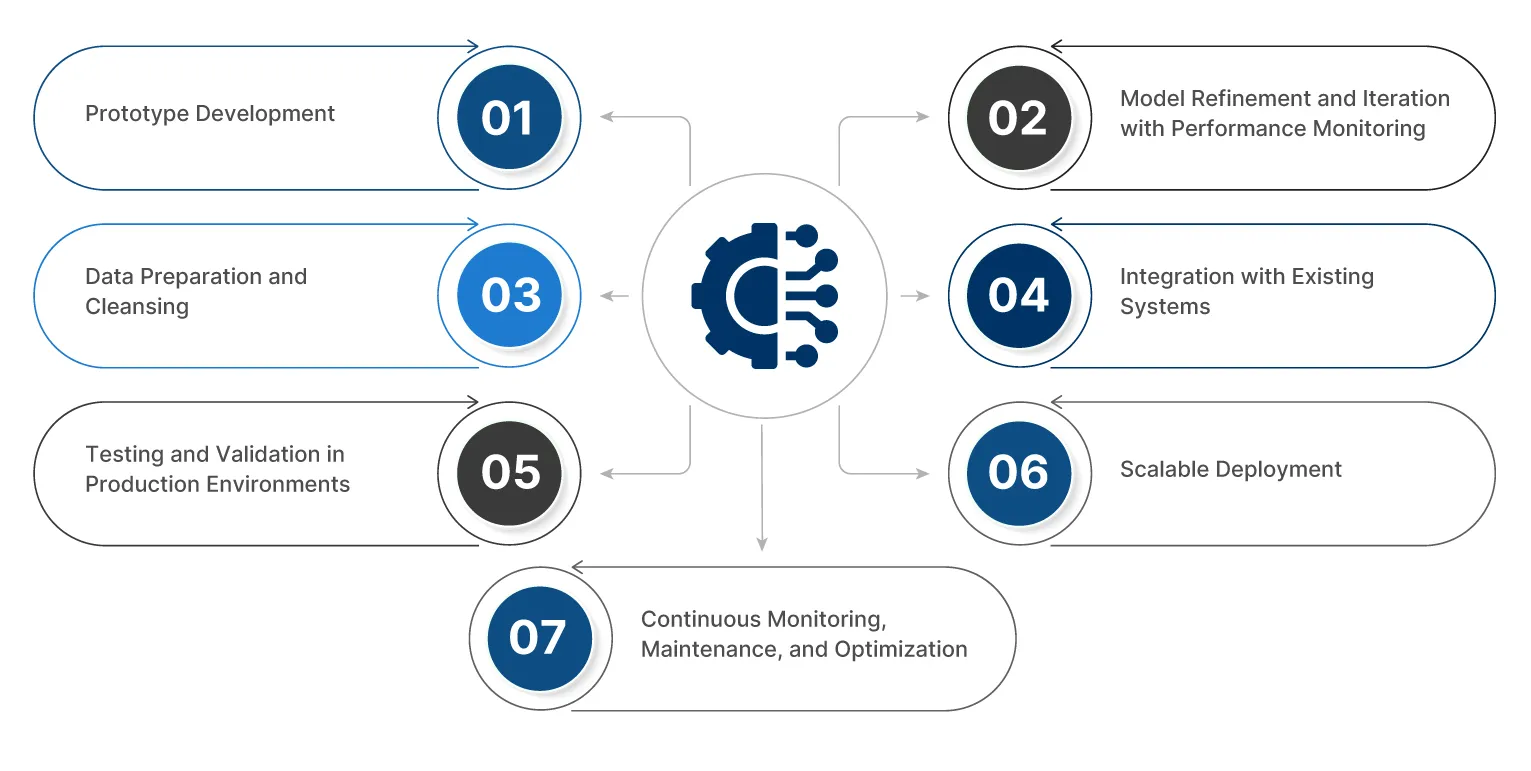
Integrating generative AI into business applications involves a series of key steps, starting from the initial concept to full-scale production. A structured approach helps businesses ensure that their AI solutions are scalable, effective, and aligned with strategic goals. Here are the 7 essential steps for a successful integration:
1. Prototype Development
The first step in the integration process is developing a prototype or proof of concept. The goal here is to test the generative AI model in a controlled environment with real business data to evaluate its potential. Prototyping allows teams to identify potential challenges early, as 95% of GenAI pilots ultimately fail to scale into production without structured refinement.
2. Model Refinement and Iteration with Performance Monitoring
Once the prototype is developed and tested, the next step is refining the model based on feedback from testing. This iterative process involves adjusting the model to improve performance, accuracy, and reliability. Businesses must also track operational metrics such as latency, throughput, per query cost, and output quality during each iteration. These parameters help teams balance performance, reliability, and cost before moving to production.
3. Data Preparation and Cleansing
Before deploying the AI solution into business operations, ensuring data quality and readiness is critical. In this step, businesses must clean and structure the data to ensure its usable for training and ongoing model optimization. Proper data preparation includes removing duplicates, correcting errors, and addressing any missing values.
A common example is RAG, where the model pulls the most relevant content from your approved documents before generating a response. This makes data cleansing and structuring critical so retrieval returns accurate, up to date information and reduces hallucinations.
4. Integration with Existing Systems
One of the most important steps in the integration process is ensuring that the AI model works seamlessly with existing business systems. This includes integrating the AI model into current IT infrastructure, databases, customer relationship management (CRM) systems, and other tools.
The integration process might involve setting up APIs or developing middleware to facilitate communication between the AI system and existing applications. It’s crucial that the integration is smooth and doesn’t disrupt ongoing operations.
5. Testing and Validation in Production Environments
After integration, it’s essential to test the AI system in a live, production environment to validate that it operates as expected. This phase ensures that the system performs under real-world conditions and provides businesses with the opportunity to fix any last-minute issues. During this step, businesses should simulate normal workflows and measure how the AI system performs.
Human in the loop review should be part of production validation to confirm the AI outputs are accurate, safe, and aligned with business policies. Start with sampled reviews or approval workflows for high impact cases, then use reviewer feedback to improve prompts, retrieval quality, and model behavior before full rollout.
6. Scalable Deployment
With testing complete, businesses can begin the process of scaling the AI solution across different business functions. This involves gradually expanding its reach from a single department or use case to the entire organization. Scaling should be done in phases, starting with high-impact areas like customer service or sales and then extending to other areas like marketing or product development.
By scaling incrementally, businesses can monitor the AI’s effectiveness at each stage and ensure it aligns with evolving needs.
7. Continuous Monitoring, Maintenance, and Optimization
The work doesn’t stop once the AI solution is deployed. Ongoing monitoring is essential to ensure that the system continues to perform effectively. It includes tracking key performance indicators (KPIs), assessing the quality of AI outputs, and identifying any areas where the model may need to be updated or optimized.
Regular maintenance ensures that the model adapts to changes in business data, consumer behavior, and market conditions. Continuous optimization is necessary to keep the solution aligned with business goals and maximize its long-term value.
Irregular monitoring can allow issues like data drift, concept drift, and prompt or retrieval changes to go unnoticed, which can reduce output quality over time. To manage this, set automated alerts and periodic evaluation checks so teams can detect shifts early and retrain, re index, or adjust prompts before performance degrades.
Following the steps mentioned above, enterprises can ensure that their generative AI solution is effectively integrated and is continuously optimized to deliver long-term value.
Scaling Generative AI: Change Management, Operations and Monitoring
To address cultural resistance, businesses must educate employees on AI’s benefits, offer training on its tools, and provide ongoing support. This helps mitigate fears that AI might replace jobs or be too complex to use.
Operationally, businesses need to ensure that AI models continue to perform well as they handle larger data volumes and expand across functions. Regular monitoring is key to identifying and addressing any performance issues or biases early, ensuring smooth scaling.
How TxMinds Enables Seamless Gen-AI Integration and Delivers Measurable Value
At TxMinds, we help businesses integrate generative AI by aligning technology with strategic objectives. Our Gen AI development services ensures that AI solutions are tailored to your needs, driving measurable business results from the outset.
We focus on developing production-ready systems that are scalable and easily monitored. By leveraging advanced AI models and embedding governance and optimization from the beginning, we ensure seamless integration with your existing systems. Our solutions include custom AI development, intelligent automation, and deployment accelerators that integrate directly into your workflows, enabling you to scale your AI capabilities efficiently and sustainably.
Amar Jamadhiar is the Vice President of Delivery for TxMind's North America region, driving innovation and strategic partnerships. With over 30 years of experience, he has played a key role in forging alliances with UiPath, Tricentis, AccelQ, and others. His expertise helps Tx explore AI, ML, and data engineering advancements.
FAQs
How to integrate generative AI into business applications at scale?
Start by selecting high-impact use cases, building a prototype, refining with performance monitoring, integrating with existing systems, validating in production with human review, and then scaling incrementally with continuous optimization.
What is step-by-step roadmap for GenAI implementation in enterprises?
The roadmap is: prototype development, model refinement and monitoring, data preparation and cleansing, integration with existing systems, production testing and validation, scalable deployment, and continuous monitoring and maintenance.
What are the best practices for scaling generative AI in production?
Use clean and governed data, track latency/throughput/cost/output quality, include human-in-the-loop validation for high-impact workflows, deploy in phases, and set automated alerts to catch drift and quality issues early.
How can organizations modernize legacy applications?
Modernize by integrating GenAI via APIs or middleware into legacy systems, then harden the solution with governance, security, testing, monitoring, and iterative improvements to meet enterprise reliability and compliance needs.