


Recommended Blogs

Blog
Generative AI App Modernization: Driving Unmatched Acceleration in Legacy Revamps
Table of Content
- Overcoming Modernization Hurdles with Generative AI
- The Roadmap for Adopting Generative AI for Legacy Transformation
- The Transformative Power of Generative AI in Legacy Modernization
- Challenges Ahead and the Strategic Considerations for Successful Implementation
- How TxMinds Leads the Charge in GenAI-Driven Legacy Modernization
Share On


Most enterprises today live with a quiet contradiction. On one side, there are bold digital roadmaps and aggressive growth targets. On the other hand, there are mainframes, monoliths, and tangled legacy apps that still run the core business. The result is a widening gap between what the enterprise wants to do and what the tech stack can support.
It is where generative AI app modernization matters. Instead of relying only on slow, manual discovery and rewrites, teams are using generative AI for application modernization to read old code, map dependencies, extract business rules, and propose cleaner designs. Work that once demanded large specialist teams over the years can now be compressed into months with a smaller, AI-augmented crew.
When used thoughtfully, AI-powered application modernization goes beyond cost reduction. Research shows businesses can expect over 200% ROI in three years. It frees the organization from legacy constraints.
Read our latest blog and explore how your enterprise can adopt generative AI application modernization to overcome the legacy system challenges.
Key Takeaways
- Legacy systems create gaps in digital goals; generative AI app modernization cuts years of work to months.
- AI-powered modernization delivers over 200% ROI in three years, solving opaque code and skill shortages.
- Follow a roadmap: target high-pain apps, build AI dependency maps, tailor per-app strategies, reuse patterns.
- GenAI app modernization shortens timelines, lowers risks with better tests, unlocks API value, and addresses code and governance issues.
Overcoming Modernization Hurdles with Generative AI
The typical legacy estate isn’t one old system; it’s an ecosystem of aging platforms held together by fragile integrations. Mainframes that know every critical process. Client–server apps nobody wants to touch. Custom code in languages your new hires have never heard of.
The hurdles are familiar:
- Opaque code and missing documentation: Understanding how things actually work can take months.
- Risky change windows: A “small tweak” can break billing, claims, or logistics overnight.
- Shrinking skills: Experts in legacy stacks are retiring faster than they can be replaced.
- Overgrown technical debt: Every new feature feels harder and more expensive than the last.
This is the environment where generative AI app modernization and legacy application modernization with generative AI come into play. By ingesting code, schemas, and logs, generative AI for system modernization can rapidly surface dependencies, hidden business rules, and dead code.
Instead of guessing where to start, you see clearly where legacy app revamp using generative AI will deliver the most impact with the least risk.
The Roadmap for Adopting Generative AI for Legacy Transformation
A successful journey with generative AI app modernization needs more than tools. It needs a practical, staged plan.
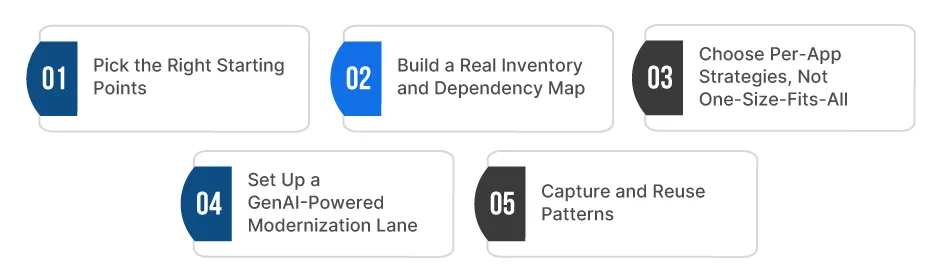
1. Pick the Right Starting Points
Focus on systems where pain is high and scope is contained: a customer-facing app trapped on an old stack, or a core batch process blocking change. These are ideal for proving how generative AI accelerates app modernization.
2. Build a Real Inventory and Dependency Map
Use generative AI for accelerating legacy modernization to scan code, jobs, and interfaces, and build a living map. This becomes your guide for legacy application modernization with generative AI, not a static spreadsheet.
3. Choose Per-App Strategies, Not One-Size-Fits-All
Some systems need rehosting, some refactoring, some complete rebuilds. Insights from generative AI for application modernization help estimate effort and risk instead of relying on gut feel.
4. Set Up a GenAI-Powered Modernization Lane
Create a delivery lane where AI-powered application modernization is fully integrated into analysis, coding, testing, and documentation. Start with a small portfolio, prove the model, then expand.
5. Capture and Reuse Patterns
Every success becomes a template. Prompts, workflows, and architectures from the first legacy app revamp using generative AI should feed the next wave, turning one-off wins into an operating model.
The Transformative Power of Generative AI in Legacy Modernization
When this roadmap is in motion, the impact of generative AI for application modernization becomes visible very quickly. Timelines shrink because the slowest parts of modernization, like code analysis, documentation, and test creation, are accelerated by generative AI app modernization. Teams spend less time figuring out what they’re looking at and more time designing where they want to go.
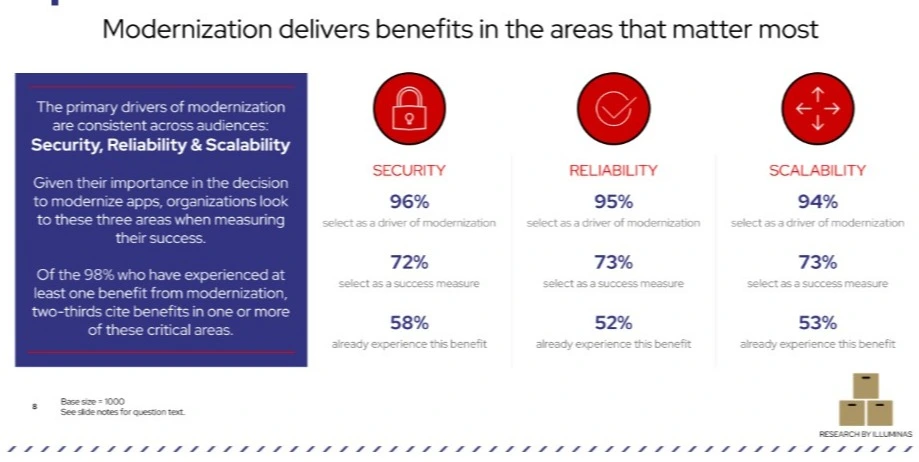
Risk drops as well. Better visibility and stronger test coverage mean fewer surprises when changes hit production. For organizations modernizing mainframes and monoliths with generative AI, being able to see exactly which jobs, screens, and interfaces depend on a component turns upgrades from guesswork into engineering.
Finally, value increases. Once legacy systems are decomposed, wrapped with APIs, and better tested, they become easier to extend. New digital products, partner integrations, and downstream AI use cases stop being blocked by “the old system.” This is what generative AI-driven legacy system transformation really means: the core stops holding innovation hostage.
Challenges Ahead and the Strategic Considerations for Successful Implementation
There are real challenges in adopting generative AI for application modernization. One is code correctness. Models can generate code that compiles but subtly misinterprets a business rule. That’s why AI-powered application modernization must be wrapped in strong automated testing, static analysis, and human review.
Another challenge is security and data governance. Legacy systems often contain sensitive data and proprietary logic. Clear policies are needed on what can be fed into which tools, how outputs are reviewed, and how audit trails are maintained. Governance must grow with generative AI for accelerating legacy modernization, not trail behind it.
There’s also a skills and culture shift. Architects and developers need to be comfortable using generative AI to modernize legacy applications as part of their daily flow, not as an occasional experiment. That means training, pairing patterns, and updated success metrics that measure outcomes, not just effort. Getting this right turns legacy application modernization with generative AI from a pilot project into a lasting capability.
How TxMinds Leads the Charge in GenAI-Driven Legacy Modernization
At TxMinds, we approach generative AI app modernization with a simple belief: modernization should create visible business value in months, not years, and it shouldn’t put the core at risk. With our application modernization services, we build a living map of your legacy estate, uncover the real business rules inside it, and identify where a targeted legacy app revamp using generative AI will deliver maximum impact with minimum disruption.
We embed AI-powered application modernization into your delivery pipelines, share playbooks for generative AI-driven legacy system transformation, and help your engineers get comfortable using generative AI to modernize legacy applications as part of their everyday work.


Vivek Gupta
VP, Delivery, Digital Engineering
Vivek Gupta is the Vice President of Delivery at Tx with over 25 years of experience driving digital transformation. At Tx, he has built the foundation for DevOps, Digital, and Cloud practices, shaping strategies that empower businesses. Before joining Tx, Vivek held leadership roles at Infosys and Tech Mahindra. His leadership fuels innovation, strengthens delivery excellence, and enhances Tx's global impact. Vivek's commitment to driving change ensures our clients stay ahead in an evolving digital landscape.
FAQs
What is Generative AI for accelerating legacy modernization?
Generative AI for accelerating legacy modernization scans code, maps dependencies, and extracts rules to shrink years of manual work into months.
How does using Generative AI to modernize legacy applications work?
Using generative AI to modernize legacy applications uncovers hidden business logic and dead code, enabling targeted revamps with minimal risk.
How does Generative AI accelerate app modernization?
Generative AI accelerates app modernization by automating analysis, documentation, and testing, freeing teams to focus on innovation over legacy hurdles.
What is a Generative AI-driven legacy system transformation?
Generative AI-driven legacy system transformation delivers over 200% ROI in three years by decomposing monoliths, adding APIs, and unlocking new digital products.
Discover more