Imagine if your business could scale instantly, cut operational costs, and accelerate innovation, all without the headache of managing servers. Serverless architecture makes this a reality. It is not just another tech upgrade; it is a radical shift that allows companies to focus on growth, not infrastructure.
The rapid adoption of serverless computing is reflected in the market’s impressive growth, from a global size of USD 17.78 billion in 2025 to a projected USD 124.52 billion by 2034, growing at a CAGR of 24.23%. This surge highlights widespread technological investment and the strategic importance of serverless models for modern enterprises.
For leaders, this is a pivotal moment. Serverless computing offers an opportunity to transform how you operate by eliminating inefficiencies, speeding up development, and giving your teams the agility to respond faster to market demands. It’s about seizing control over how you innovate and create value, all while staying ahead of the curve.
But like any major change, the shift to serverless infrastructure is not without its challenges. In this blog, we will dive into how serverless architecture can redefine your business model, the risks involved, and why now might be the time to make this strategic leap.
Key Takeaways
Serverless architecture market surges from $17.78B in 2025 to $124.52B by 2034 at 24.23% CAGR.
Serverless offers pay-per-use cost savings, auto-scaling, and agility without server management.
Ideal for variable workloads, serverless auto-handles resources unlike traditional manual provisioning.
Challenges include vendor lock-in, cold starts, limited control, debugging issues, and state management complexity.
The Benefits of Going Serverless: Cost Savings, Scalability, and Agility
Serverless architecture is a cloud computing model where developers can build and run applications without having to manage servers. In serverless computing, the cloud provider takes responsibility for provisioning, scaling, and managing infrastructure. This means businesses don’t have to worry about server maintenance or capacity planning. Instead, they focus on writing code, which makes the process more efficient and cost-effective.
Various benefits of serverless architecture include:
1. Cost Savings with Serverless Architecture
A key advantage of serverless architecture is its cost efficiency. Traditional infrastructure requires businesses to provide resources for peak capacity, often leading to underutilized servers. With serverless computing, you only pay for the compute power your application uses, which drastically reduces operating costs. The serverless application architecture operates on a pay-per-use model, ensuring businesses avoid the expenses associated with idle resources.
2. Scalability Without the Hassle
Scalability is built into the core of serverless infrastructure. Unlike traditional models, where scaling requires manual configuration and often leads to over-provisioning, serverless computing scales are automatically based on demand. The serverless application framework ensures that applications can handle unexpected traffic spikes without the need for additional infrastructure management, making it a more flexible and cost-effective solution.
3. Agility and Faster Development
The abstraction of infrastructure in serverless architecture allows development teams to focus on writing code and deploying applications faster. Serverless computing enables quicker time-to-market by removing the complexity of server management and allowing for rapid iterations and updates. With serverless application frameworks, deploying new features becomes easier, helping businesses stay agile and responsive to changing needs.
How Serverless Architecture Reduces Operational Overhead and Complexity
Managing infrastructure is no small feat. For many organizations, it consumes valuable resources, requiring dedicated teams to handle provisioning, maintenance, updates, and scaling. Serverless architecture flips this model on its head by abstracting the complexity of infrastructure management.
Let’s break down how serverless computing makes operations simpler and more efficient.
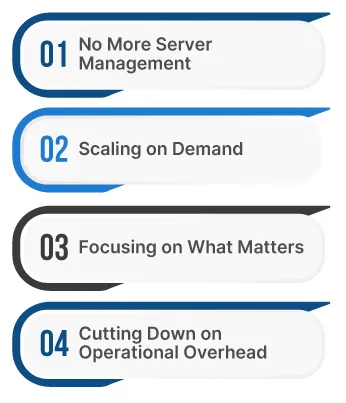
1. No More Server Management
One of the biggest time-savers in serverless computing is that businesses no longer have to worry about provisioning and managing servers. In a traditional setup, teams must ensure hardware is configured correctly, update systems, and troubleshoot failures. With serverless architecture, all of that is taken care of by the cloud provider. The only thing technical team need to focus on is the application itself.
2. Scaling on Demand
Scaling applications manually is often a cumbersome and time-consuming task with traditional infrastructures. Serverless architecture removes this burden. With serverless computing, resources automatically scale based on the needs of your application. Whether it’s handling traffic spikes during peak periods or scaling back during quieter times, the serverless infrastructure takes care of everything.
3. Focusing on What Matters
When you use serverless application architecture, infrastructure management is no longer in your hands. It means developers can focus on what they do best: writing code that delivers value to the business. No more concerns about server uptime, security patches, or network issues. Serverless infrastructure handles these background processes, enabling teams to be more productive and responsive.
4. Cutting Down on Operational Overhead
With serverless architecture, the ongoing operational tasks such as maintenance, patching, and system updates are fully automated. These routine tasks are taken off your plate, allowing your team to focus on delivering value through new features and applications. The cloud provider handles heavy lifting, so there is less chance for human error, and fewer people need to be involved in keeping things running smoothly.
Real-World Use Cases: When and Why Serverless Infrastructure Makes Sense
Serverless architecture is perfect for a variety of real-world scenarios. Here are when and why businesses turn to serverless computing for efficient, scalable solutions:
1. Handling Variable Workloads
For applications with unpredictable or fluctuating traffic, serverless computing scales automatically, ensuring resources are used only when needed.
Example: An e-commerce website experiences a surge in traffic during seasonal sales. With serverless architecture, the application scales instantly to handle the spike, then scales down once traffic returns to normal, reducing costs and management complexity.
2. Microservices and Modular Applications
Serverless architecture is ideal for microservices, where individual components can be deployed and scaled independently.
Example: A media streaming service uses serverless application frameworks to handle separate tasks like user authentication, content delivery, and notifications. Each service scales independently, making the system more efficient and easier to maintain.
3. Real-Time Data Processing
For real-time applications that need to process data continuously, serverless computing automatically scales to handle high data volumes without manual intervention.
Example: An IoT platform uses serverless architecture to process data from thousands of connected devices. As the number of devices increases, the system automatically scales to process data in real time, without requiring additional infrastructure.
4. Startups and Small Businesses
For startups and small businesses, serverless architecture provides a cost-effective way to scale without requiring significant infrastructure investments.
Example: A startup developing a mobile app can rely on serverless infrastructure to handle user sign-ups, payment processing, and notifications, all while focusing on product development rather than server management.
Serverless vs Traditional Infrastructure: A Comparison of Key Differences
When deciding between serverless architecture and traditional infrastructure, it is crucial to compare key factors, including resource management, cost models, scalability, and maintenance. Below is a side-by-side comparison of the two models:
Aspect
Serverless Architecture
Traditional Architecture
Resource Management
Automatic scaling based on demand, no manual server management.
Manual provisioning and scaling of resources is required.
Cost Model
Pay-per-use model: only pay for the compute time your app uses.
Fixed costs: pay for resources regardless of use (e.g., server uptime).
Scalability
Automatic, real-time scaling based on application demand.
Manual scaling or pre-provisioning is required to meet demand.
Maintenance and Overhead
Managed by a cloud provider, with automatic updates and security.
Requires regular maintenance, security patches, and resource monitoring.
Serverless architecture offers significant advantages in terms of cost-efficiency, scalability, and reduced operational overhead. However, traditional infrastructure may still be the better choice for organizations that require full control over their resources and systems. The right choice depends on your specific needs, traffic patterns, and the level of infrastructure management your team is prepared to handle.
Challenges in Adopting Serverless Computing: What to Consider Before Making the Move
While serverless computing offers numerous advantages, it also presents challenges that require careful consideration. Before moving to serverless computing, organizations should weigh the potential drawbacks and how they might impact their specific needs.
Here are some of the key challenges businesses should be aware of:
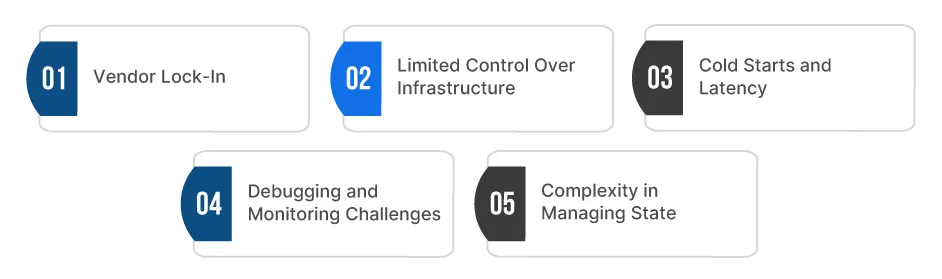
Vendor Lock-In: Once you commit to a cloud provider’s serverless infrastructure, it becomes difficult to migrate to another provider, as your application becomes dependent on their tools and services.
Limited Control Over Infrastructure: With serverless computing, the cloud provider manages the underlying infrastructure, resulting in less control over the environment and potentially hindering customization or addressing specific security needs.
Cold Starts and Latency: Serverless architecture can introduce latency, particularly when functions aren’t used for an extended period. The startup delay, commonly referred to as a “cold start,” can be problematic for time-sensitive applications.
Debugging and Monitoring Challenges: Since serverless applications run in a distributed environment, it can be more difficult to debug and monitor performance, especially without direct access to servers or infrastructure.
Complexity in Managing State: Serverless architecture is ideal for stateless applications, but managing state (such as user sessions or long-running processes) can be challenging and may require additional services, like external storage or databases.
TxMinds: Helping Your Business Leverage Serverless for Innovation and Growth
At TxMinds, we combine deep cloud‑native expertise with real-world experience to build serverless solutions that align with your business goals. Whether you are migrating to an existing system or starting from scratch, our serverless cloud-native application development services deliver apps that scale with demand, remain resilient under load, and minimize infrastructure overhead.
Beyond just development, our experts ensure that security, performance, and compliance are built in from the start, providing you with not only the flexibility of serverless application architecture but also the reliability and governance enterprises require. With us, you get the speed and agility of a cloud-native without compromising quality or control.
Amar Jamadhiar is the Vice President of Delivery for TxMind's North America region, driving innovation and strategic partnerships. With over 30 years of experience, he has played a key role in forging alliances with UiPath, Tricentis, AccelQ, and others. His expertise helps Tx explore AI, ML, and data engineering advancements.
FAQs
What is serverless architecture?
Serverless architecture is a cloud computing model where the applications are built without worrying about management, provisioning, and scalability of the servers, as the cloud provider handles provisioning, scaling, and infrastructure.
What are the benefits of serverless architecture?
Benefits of serverless architecture include cost savings via pay-per-use, automatic scalability for demand spikes, and increased developer agility by eliminating server management and maintenance.
When to Use Serverless Architecture?
Use serverless architecture for variable workloads with unpredictable traffic, such as handling spikes, where automatic scaling and pay-per-use efficiency outperform traditional manual provisioning.
What are serverless architecture pros and cons?
Serverless architecture pros are cost-efficient, auto-scaling, and reduced overhead; cons include vendor lock-in, cold starts causing latency, limited infrastructure control, and debugging challenges in distributed environments.