


Recommended Blogs

Blog
Is Security Holding You Back? How DevSecOps Transforms It into a Business Advantage
Table of Content
- From Gatekeeper to Growth Killer: Why Traditional Security Slows Business Down
- What DevSecOps Security Really is (and isn’t): Principles of Security-by-Design
- Flipping the Script: How DevSecOps Turns Risk Reduction into Business Value
- DevSecOps Best Practices That Make Security a Speed Enabler, not a Roadblock
- Measuring the Upside: Metrics That Prove Security Is a Competitive Edge
- TxMinds: Driving DevSecOps Innovation and Excellence for Your Business
- Conclusion: Security as Acceleration, Not Obstacle
Share On


Every business today is under pressure to innovate and release products quickly. But for many, security remains a major roadblock. Traditional security processes slow down development, leading to delays, added costs, and potential vulnerabilities. The truth is, waiting until the end of the development cycle to address security simply doesn’t work anymore. It’s not just slowing you down; it’s putting your entire product and reputation at risk.
So, how can you keep up with the demand for speed without sacrificing security? The answer lies in DevSecOps. This approach integrates security directly into every stage of the development process. With DevSecOps, security becomes a built-in part of your pipeline, protecting your code automatically and ensuring continuous compliance.
In this blog, we will explore how DevSecOps can transform security from a roadblock into a business advantage. Know how it accelerates innovation, reduces risks, and helps you deliver faster, more secure software, while giving you a competitive edge. Keep reading to find out how to make security a driving force behind your success.
Key Takeaways
- DevSecOps integrates security early, reducing risks and speeding up software delivery, offering key benefits for businesses.
- Security automation ensures continuous compliance without slowing development, via managed DevSecOps services.
- Shift-left security detects vulnerabilities early, saving time and costs, aligning with DevSecOps best practices.
- Collaboration across teams turns security into a business advantage, driving success through enterprise DevSecOps solutions.
From Gatekeeper to Growth Killer: Why Traditional Security Slows Business Down
Security has traditionally been a roadblock for development teams. The standard approach often involves manual checks, lengthy approval processes, and security audits conducted only after code has been developed. This “waterfall” approach to security causes delays and creates friction, often resulting in teams pushing out releases late or even halting them entirely to resolve security concerns.
In many cases, security becomes a gatekeeper instead of a guardrail, blocking progress rather than guiding it. Teams wait for security clearance before proceeding, often missing crucial market windows or piling up costly technical debt because of last-minute fixes. Traditional security approaches are often disconnected from the development cycle, which means vulnerabilities are only discovered too late, when they can cause damage to both the product and the company’s reputation.
What DevSecOps Security Really is (and isn’t): Principles of Security-by-Design
DevSecOps security is much more than just security tools integrated into your pipeline. It is a cultural and technical shift that makes security an inherent part of your development and deployment processes.

Key principles of DevSecOps:
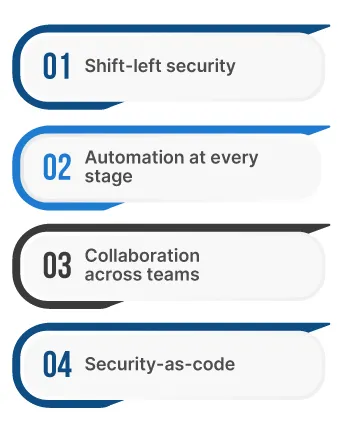
- Shift-left security: Security testing happens early in the development cycle, allowing teams to detect vulnerabilities before they become costly problems.
- Automation at every stage: From automated code analysis to continuous deployment pipelines, automation ensures that security is continuously maintained without slowing down development.
- Collaboration across teams: Security becomes a shared responsibility between development, operations, and security teams, breaking down silos and fostering a culture of security-first thinking.
- Security-as-code: Just as infrastructure is treated as code, security policies are codified and embedded into every stage of the pipeline, making compliance and security checks more consistent and predictable.
DevSecOps is about embedding security throughout the entire pipeline. It’s about creating a “security-first” mindset across teams and ensuring that security is a fundamental part of every decision.
Flipping the Script: How DevSecOps Turns Risk Reduction into Business Value
Adopting DevSecOps generates business value. When security is integrated into the development process, it leads to faster delivery times, improved product quality, and better alignment with business goals.
By shifting security left, teams can catch vulnerabilities early, which reduces the costs associated with fixing them later in the process. This translates into faster releases, which in turn means products get to market quicker, allowing businesses to stay ahead of competitors.
Additionally, because DevSecOps integrates compliance and security controls from the start, companies can confidently meet regulatory requirements and avoid the costly fines and reputational damage that often result from non-compliance. In short, businesses that embrace DevSecOps can have faster, more secure releases that contribute directly to their bottom line.
DevSecOps Best Practices That Make Security a Speed Enabler, not a Roadblock
One of the key reasons DevSecOps works so well is the emphasis on automation. By automating repetitive tasks, teams free up valuable time and resources that would otherwise be spent on manual security checks.
Here are some DevSecOps best practices that ensure security is enhanced:

Automated Security Testing:
Continuous integration (CI) and continuous deployment (CD) pipelines are equipped with automated security tests, such as Static Application Security Testing (SAST) and Dynamic Application Security Testing (DAST), which detect vulnerabilities before they reach production.
Infrastructure as Code (IaC):
Infrastructure is treated as code and managed through tools like Terraform or CloudFormation. It ensures environments are consistent, reducing the risk of misconfigurations and vulnerabilities due to human error.
Shift-left testing:
Security testing happens early in the development process, rather than waiting for a final audit. It ensures issues are discovered and resolved before they can hold up releases.
By embedding these practices into the development pipeline, DevSecOps creates a workflow where security isn’t an afterthought but an integral part of the process, driving both speed and quality.
Measuring the Upside: Metrics That Prove Security Is a Competitive Edge
To truly realize the value of DevSecOps, businesses need to track and measure its impact. Metrics are essential to showing how integrated security practices not only reduce risk but also provide tangible benefits.
Here are some of the key metrics to track:
Mean Time to Detect (MTTD):
The average time it takes to detect a security vulnerability. Faster detection means less time for attackers to exploit weaknesses.
Mean Time to Remediate (MTTR):
This measures how quickly vulnerabilities are fixed after they are detected. Shorter times reduce the window of exposure.
Deployment Frequency:
Companies practicing DevSecOps can release code more frequently, often multiple times per day. More frequent releases mean faster iteration and better customer satisfaction.
Change Failure Rate:
This metric measures the frequency of changes to production that fail or result in security incidents. With DevSecOps, this rate is typically lower, reflecting the increased reliability and quality of the code.
By tracking these metrics, businesses can demonstrate that DevSecOps isn’t only a means to mitigate risks but also a method to drive performance, enhance product quality, and gain a competitive edge.
TxMinds: Driving DevSecOps Innovation and Excellence for Your Business
TxMinds specializes in helping businesses implement DevSecOps, focusing on automation, security integration, and streamlined compliance processes. Our DevSecOps consulting services ensure that security is seamlessly embedded throughout the development pipeline, enabling faster releases without compromising quality or safety. Through tools like automated security testing, continuous integration, and infrastructure as code (IaC), TxMinds helps organizations deliver secure, compliant software at scale.
With TxMinds, businesses can reduce operational overhead, enhance their security posture, and remain compliant with industry regulations while accelerating their time-to-market. Their expertise in DevSecOps implementation ensures that security doesn’t become a bottleneck but rather a catalyst for innovation and growth.
Conclusion: Security as Acceleration, Not Obstacle
In today’s competitive landscape, speed is a key differentiator, and security should never hinder you. By adopting DevSecOps, you can transform security from a necessary evil into a business advantage, enabling faster and more secure releases, as well as a stronger product offering.
DevSecOps is about integrating security into the heart of the development process, automating key tasks, and fostering collaboration across teams. The result? Reduced risk, improved business value, and a more efficient, scalable process that delivers high-quality products faster.


Vivek Gupta
VP, Delivery, Digital Engineering
Vivek Gupta is the Vice President of Delivery at Tx with over 25 years of experience driving digital transformation. At Tx, he has built the foundation for DevOps, Digital, and Cloud practices, shaping strategies that empower businesses. Before joining Tx, Vivek held leadership roles at Infosys and Tech Mahindra. His leadership fuels innovation, strengthens delivery excellence, and enhances Tx's global impact. Vivek's commitment to driving change ensures our clients stay ahead in an evolving digital landscape.
FAQs
What is DevSecOps?
-
DevSecOps integrates security into every stage of development, promoting early vulnerability detection, automation, and continuous compliance. It accelerates software delivery while ensuring better security and reducing risks.
Why is DevSecOps important?
-
DevSecOps integrates security early in development, reducing risks and delays. It automates security checks, enabling faster releases and improving compliance, which leads to better software quality and a competitive edge.
How to implement DevSecOps?
-
Implement DevSecOps by automating security tests (SAST, DAST) in CI/CD pipelines, using Infrastructure as Code (IaC), shifting security left to detect issues early, and fostering cross-team collaboration to make security a shared responsibility.
What are the key components of DevSecOps?
-
Key components include shift-left security, automation of security tasks, collaboration across teams, security-as-code, and continuous compliance, ensuring security is embedded throughout the development lifecycle.
How DevSecOps turns security into a business enabler?
-
DevSecOps embeds security throughout the development process, reducing risks and delays. Automating security checks and catching vulnerabilities early accelerates software delivery, improves quality, and helps businesses stay ahead of competitors.
Discover more