Did you know that tech is the top lever for reinvention for 98% of enterprises, and Gen AI is one of the main levers for 82% of these companies?
That tells us something simple but important: Generative AI is moving into the center of how companies plan growth, shape their products, and think about the next phase of their business.
Across sectors, leadership teams are finding that this is not just another round of digitization. Generative tools are changing how ideas are developed, how work gets done, and how customers interact with brands day to day. The companies that move early are using this moment to rethink their Generative AI business models, while others are still stuck running isolated proofs of concept.
This blog looks at how that gap is opening. It explores where Generative AI is touching the business model, how it is reshaping customer experiences and operating models, what it means for governance and trust, and what leaders can do now to turn experiments into real, sustained AI-driven business transformation.
Key Takeaways
Technology drives reinvention for 98% of enterprises, with generative AI as a key lever for 82% of them.
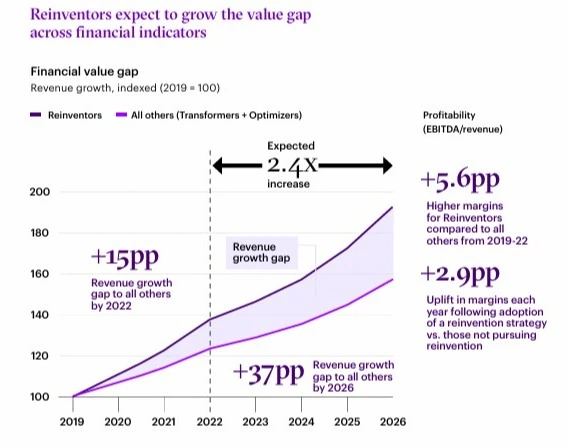
Leading companies grew revenues 15 points more than peers in 2022 and expect this gap to reach nearly 40 points by 2026. Profitability is over 5 points higher.
Generative AI is now a CEO-level priority, enabling true business reinvention across value creation and delivery.
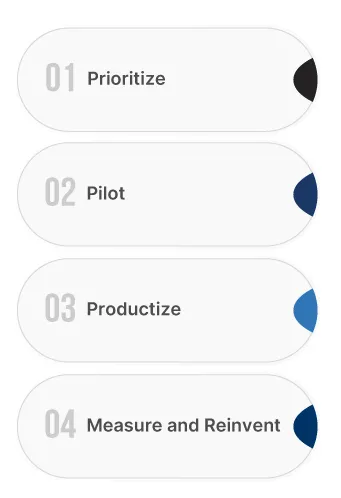
Success comes from a clear playbook: prioritize, pilot, productize, and measure to turn AI experiments into lasting growth.
Why Generative AI is Now a CEO-Level Imperative
Generative AI has moved from experimentation to a boardroom priority. It is changing how value is created, how fast companies can move, and what customers now expect as standard. The leaders who act early are using it to reshape their growth agenda, not just adding a new feature or running a few pilots.
Three shifts make this urgent. The economic impact reaches into product design, customer interaction, marketing, operations, and knowledge of work, rather than staying in the back office. Customer expectations are rising as they experience more personalized, responsive, and intelligent services in other parts of their lives. Competitors that adopt early are learning faster, reducing costs, and opening new revenue streams, while others are still debating where to begin.
Generative AI matters now because it enables reinvention, not only efficiency. It gives leadership teams a way to rethink what the business offers, how it operates, and where it competes. The real divide emerging is between enterprises that treat Generative AI as a strategic mandate and those that treat it as a side project.
A clear gap is already forming between those who use Generative AI to run a few experiments and those who use it to build a repeatable engine of reinvention. The second group is not just deploying more tools; they are rewiring how strategy, technology, and operations connect. Over time, this small set of “reinventor” organizations is likely to pull away in growth, margins, and innovation speed, while others find it harder to catch up.
How Generative AI Business Models are Reshaping Business Models
Most organizations start using Generative AI to save time and cut effort. That is useful, but it is only the first layer. The bigger opportunity is to rethink how businesses create value, serve customers, and make money. The leading enterprises are already using Generative AI to redesign the business model, not just improving a few processes.
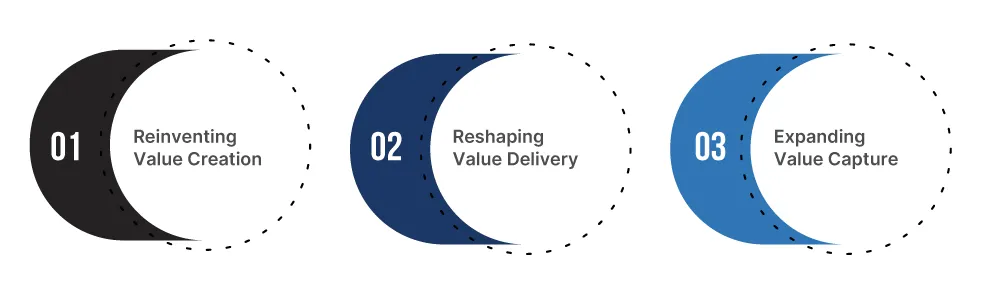
1. Reinventing Value Creation
Generative AI lets companies imagine and build things they could not easily deliver before. Teams can move from ideas to prototype much faster, test more options, and refine offerings in days instead of months. This is changing how new products, services, and personalized experiences are conceived and launched.
The performance gap between companies that pursue true AI-powered business reinvention and those that simply optimize is widening fast. Research shows that businesses leading on reinvention grew revenues of 15% points more than their peers by 2022 and are on track to widen that gap to nearly forty points by 2026. Their profitability also stands more than five points higher. This is not a marginal improvement; it is a structural advantage that compounds over time.
2. Reshaping Value Delivery
Service models are becoming more responsive and tailored. Generative tools can adjust conversations, content, and support flows in real time based on context and behavior. That means customer journeys feel more relevant; interactions are more consistent, and complex tasks become simpler for both customers and employees.
3. Expanding Value Capture
New revenue streams are starting to emerge. Organizations are packaging insights from their data, embedding generative capabilities into existing products, or shifting towards subscription and outcome-based Generative AI business models. Instead of only taking the cost out of today’s business, they are using Generative AI to open tomorrow.
These shifts move Generative AI out of the “productivity” bucket and into the heart of strategy. The real divide is forming between companies that use it to fine-tune the current model and those using it to reinvent how their business works.
Designing GenAI–Driven Value Propositions and Customer Experiences
Generative AI is pushing organizations to rethink what they offer and how customers experience it. Instead of layering AI onto existing products or journeys, leading companies are stepping back and asking a more fundamental question: If we were designing this from scratch in a Gen AI world, what would it look like?
This shift is changing the shape of value propositions in three important ways.
Personalization that feels human, not automated: Generative AI makes it possible to tailor experiences at a much deeper level than traditional segmentation. Customers can receive guidance, content, and recommendations that feel precisely suited to their context, preferences, and intent. This goes beyond targeted marketing and reaches into service, product usage, onboarding, and support.
Products and services that adapt in real time: Customer needs rarely stay static. With Generative AI, offerings can evolve continuously based on behavior and feedback. Whether it is a financial plan adjusting to new spending patterns or a learning path adapting to progress, the product becomes a dynamic companion rather than a fixed asset.
Experiences that remove friction and increase confidence: Generative AI can simplify complex decisions, translate technical information into plain language, and guide users through tasks that once felt intimidating. This reduces effort for customers and builds trust, especially in industries where choices are high-stakes or information-heavy.
As businesses explore these possibilities, a clear pattern is emerging. The most compelling value propositions are not defined by the technology itself, but by the new outcomes it enables customers to have.
Reimagining Operating Models: Data, Talent, and Risk for Gen AI at Scale
Generative AI will not change much if it sits in a few pilots while the rest of the organization runs on old structures and habits. To get real impact, companies need to tune the way they operate: how data is handled, how teams work together, and how risk is managed. The goal is simple: make it easy for the business to use Gen AI safely, repeatedly, and on a scale.
Key shifts in the operating model:
Data: Create a shared, well-governed data foundation so Gen AI can plug into real workflows instead of isolated sandboxes. Fewer silos, clearer ownership, and simple rules on quality and access.
Talent and ways of working: Build cross-functional teams where business, technology, and risk work together from the start. Encourage shorter delivery cycles, rapid testing, and learning by doing.
Ownership and accountability: Assign clear owners for critical Gen AI use cases, including performance, impact, and ongoing improvement. Make sure decision rights are explicit, so issues do not drift between teams.
Risk and controls: Establish practical guardrails for where and how Gen AI can be utilized, particularly in sensitive data and customer-facing scenarios. Monitor outputs, capture incidents, and refine policies as the organization learns and evolves.
With these elements in place, Gen AI can move from “experiments on the side” to a core part of how the organization runs and grows.
Governance, Trust, and Regulatory Readiness for Enterprise Gen AI
Without the right guardrails, even the best Gen AI strategy can stall. Effective governance is less about slowing things down and more about creating confidence; so, digital transformation with generative AI can move forward responsibly.
Key elements of a scalable governance approach include:
1. Clear Usage Guidelines
Set out where generative tools can be used, what data they can touch, and when a human needs to review or approve an outcome.
2. Strong Data Safeguards
Protect sensitive data with clear access rules, masking or anonymization where needed, and strict logging of who uses what.
3. Quality and Oversight
Define minimum standards for accuracy and reliability, especially in customer-facing or high-impact processes.
4. Regulatory and Policy Compliance
Track emerging rules in your markets and document how key use cases work, what checks are in place, and how issues are handled.
Execution Playbook: Prioritize, Pilot, Productize, and Measure
Generative tools only change the business when they transition from slide decks and experiments into everyday use. That shift does not need a huge manual, but it does need a simple, repeatable way of working that leaders can sponsor, and teams can follow.
A practical execution flow can look like this:
1. Prioritize
Start with a short list of high-value problems, rather than focusing on technology. Focus on areas where you can make a significant impact on revenue, cost, risk, or customer experience, and where the data and processes are mature enough to support change.
2. Pilot
Design small, time-bound pilots that test real scenarios with real users. Establish foundational guardrails for data, quality, and approvals from the outset. Treat each pilot as a learning sprint, not a one-off showcase.
3. Productize
Transform successful pilots into stable products or services that form the organization’s digital core and integrate with existing systems and workflows. Define ownership, support, and change processes so they do not remain “special projects.”
4. Measure and Reinvent
Track a few clear outcomes for each use case: business impact, user adoption, productivity, quality, and risk. Retire what does not work, scale what does, and keep feeding the next wave of ideas. Reinvention becomes an ongoing cycle, not a program with an end date.
Over time, this kind of rhythm matters more than any single use case. It provides businesses with a clear path to transition from bold ideas to repeatable results, and to continually raise the bar as the business evolves.
Build Your Enterprise AI Adoption Roadmap with TxMinds
We at TxMinds work with enterprises that are ready to move beyond experiments and utilize Generative AI to transform their day-to-day business operations. We start with clear outcomes and priority problems, then design solutions that automate and streamline workflows, modernize legacy platforms, and create new AI-powered digital innovation that lifts productivity and customer impact.
The goal of our Generative AI development services is to turn this new wave of technology into tangible movement on revenue, cost, risk, and experience, and to make AI-driven business transformation something you can see in day-to-day results, not just in strategy decks.
To achieve this, we combine modern models and tooling with robust engineering, data foundations, and built-in controls for security, compliance, and responsible use. By working this way, we turn reinvention from a slogan into something that shows up in generative AI business models and in the numbers leaders care about.
Vivek Gupta is the Vice President of Delivery at Tx with over 25 years of experience driving digital transformation. At Tx, he has built the foundation for DevOps, Digital, and Cloud practices, shaping strategies that empower businesses. Before joining Tx, Vivek held leadership roles at Infosys and Tech Mahindra. His leadership fuels innovation, strengthens delivery excellence, and enhances Tx's global impact. Vivek's commitment to driving change ensures our clients stay ahead in an evolving digital landscape.
FAQs
How is generative AI reshaping business models across industries?
Generative AI is fundamentally transforming how organizations create, deliver, and capture value. By enabling faster innovation cycles, personalized customer experiences, and new revenue streams, it shifts businesses from optimizing existing processes to reinventing their entire business models.
What are effective C-suite strategies for generative AI integration?
Successful C-suite strategies for generative AI integration include aligning AI initiatives with business priorities, fostering cross-functional collaboration, establishing clear ownership and governance, and promoting cultural readiness to accelerate adoption and innovation at scale.
How can organizations build a roadmap for generative AI-driven business growth?
A roadmap for generative AI-driven business growth should start with identifying high-impact use cases, followed by rapid pilots with governance and quality controls. Successful pilots are then productized and integrated into core workflows.
What are some key generative AI use cases for business reinvention and competitive advantage?
Generative AI use cases for business reinvention include accelerating product innovation, personalizing customer experiences in real time, automating complex workflows, and enabling data-driven decision-making.