Recommended Blogs

Blog
From Lift-and-Shift to Lasting Impact:
Turning Cloud Migration into a High-ROI Engine
Table of Content
- Defining Cloud Migration ROI: From Cost Savings to Business Value
- Laying the Groundwork: Strategic Planning Before Migration
- How to Calculate the ROI of Cloud Migration?
- Executing the Migration: Choices That Shape Long-Term Value
- Post-Migration to Turn the Cloud into a High-ROI Engine
- Measuring What Matters: KPIs for Lasting Impact
- Driving Lasting Cloud Impact with TxMinds through Cloud Cost Optimization
Share On


Gartner says that 83% of all cloud data migration projects fail to achieve the desired results.
For years, “moving to the cloud” has been treated like a finish line. Companies rush to rehost their applications, shut down data centers, and celebrate the fact that they have finally “made the move.”
But after a few months or so, a familiar reality hits: the business is not seeing the payoff it expected. Costs do not drop as dramatically as promised. Performance gains are marginal. Teams struggle to use new cloud tools effectively. And innovation? It often remains stuck in the same old bottlenecks that existed before the migration.
This is not because the cloud is overhyped but because a cloud migration alone doesn’t create value. Lift-and-shift may get you into the cloud, but it will not change how your business operates and the outcomes it delivers, unless you go further.
The enterprises that truly win with cloud treat migration as the starting point, not the goal. They use it as a launchpad to modernize operations, speed up delivery, improve resilience, and unlock new avenues for growth.
This blog will break down what real cloud ROI looks like, why lift-and-shift alone falls short, and the strategic steps enterprises can take to turn cloud adoption into long-lasting business impact.
Key Takeaways
- Most cloud migrations fail to deliver value; 83% do not meet expectations when they stop lift-and-shift.
- Cloud ROI comes from aligning migration with clear business goals, understanding workloads, and building a realistic multi-year business case.
- The real payoff happens after migration through continuous cost optimization, modernization of key applications, and better use of cloud-native services.
- Success is measured through KPIs like uptime, incident reduction, deployment speed, cost versus usage, and customer experience improvements.
Defining Cloud Migration ROI: From Cost Savings to Business Value
For the majority of enterprises, “going to the cloud” starts and ends with lift-and-shift. Take what you already have, move it to someone else’s data center, and declare victory. It feels safe, it’s relatively quick, and on paper, it checks the “cloud migration” box.
But if you stop there, all you have really done is change the address of your workloads. The same applications, the same bottlenecks, the same ways of working; just running on different hardware. That alone rarely transforms the business, and it’s often the reason leaders look at their first few cloud bills and think, “Was this really worth it?”
Real cloud migration ROI does not come from relocation. It comes from rethinking how your systems are built and how your teams deliver value. The cloud becomes powerful when it helps you ship faster, recover faster, experiment more, and respond to customers in days instead of months. Cost is part of the equation, but it’s not the whole story.
Laying the Groundwork: Strategic Planning Before Migration
Before any workload is moved to the cloud, an organization needs a clear view of why it is migrating, what is in scope, and how success will be measured. Cloud migration delivers meaningful ROI only when it is anchored in business intent, not just in technology change.
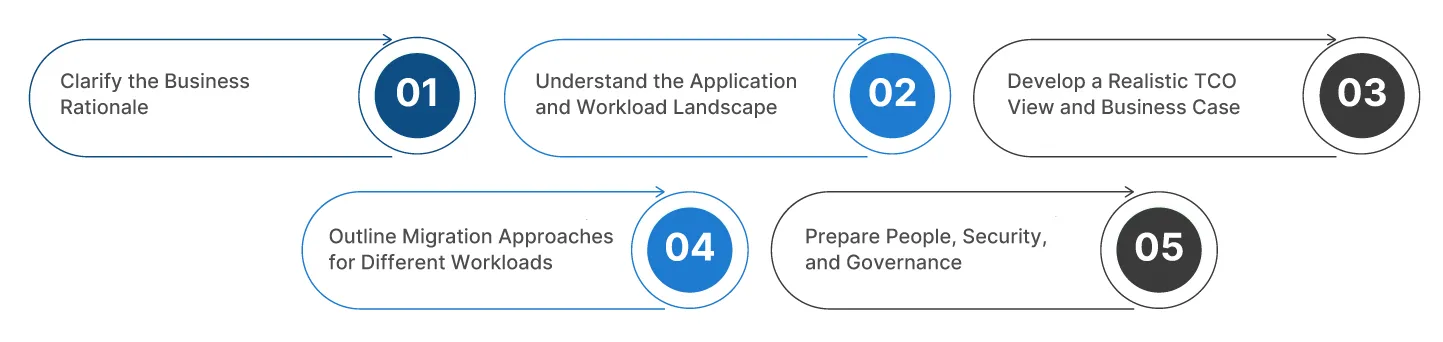
1. Clarify the Business Rationale
The starting point is a well-defined “why”. Typical drivers include faster delivery of digital products, improved reliability and availability, entry into new markets, reduction of technical debt, or the need to modernize aging infrastructure.
These drivers should be translated into a small set of concrete outcomes, for example: improving uptime core systems to a defined target, shortening release cycles, or reducing time spent on maintenance. These objectives later serve as the reference point for evaluating whether the migration has created real value.
2. Understand the Application and Workload Landscape
The next step is to understand what is being moved. This involves building an inventory of key applications, data stores, and services, as well as the dependencies between them. Which systems are customer-facing, which are internal, which are latency sensitive, and which are subject to strict regulatory requirements?
Some workloads will be suitable for early migration with minimal change, while others may be tightly coupled or fragile and require a more careful approach. A clear view of this landscape reduces the risk of disruption during and after migration.
3. Develop a Realistic TCO View and Business Case
A credible cloud business case looks beyond a simple comparison of on-premises hardware costs and cloud infrastructure pricing. It should include licenses, storage, network traffic, migration and transformation effort, support, tooling, and training.
At the same time, it should factor in the benefits: fewer incidents and outages, reduced time spent on routine maintenance, faster delivery of features and enhancements, and new opportunities enabled by cloud services. Bringing these elements together into a three-to-five-year view allows leadership to understand both the investment and the expected return.
4. Outline Migration Approaches for Different Workloads
At this stage, it is useful to set a high-level direction for how different categories of systems will move. Some applications may be rehosted initially to exit data centers quickly. Others may be replatformed to use managed databases or container platforms. Strategic, high-value systems may be earmarked for refactoring or gradual modernization to fully exploit cloud-native capabilities.
This high-level mapping makes it possible to define a phased roadmap rather than a single high-risk “big bang” move.
5. Prepare People, Security, and Governance
Finally, the foundations are incomplete without attention to people and governance. Teams need the skills to operate in the cloud, including new operational models and security practices. In parallel, basic guardrails for identity and access, data protection, compliance, and cost management should be defined before cloud usage scales.
Putting these elements in place early creates the conditions for a controlled migration and for ongoing optimization once workloads are live in the cloud.
How to Calculate the ROI of Cloud Migration?
Before organizations invest time and budget into a migration, they often want a clear way to understand what they will get in return. A simple ROI view helps frame the decision, keeping both costs and long-term benefits in focus. It also gives teams a straightforward way to communicate the value of the move to leadership and business stakeholders.
Calculate your total costs –
- Add up both one-time and ongoing costs.
- One-time costs can include planning and assessment work, data transfer, implementation and integration, and initial training.
- Ongoing costs include cloud subscriptions, support, security and compliance, and any new or changed staffing costs.
Calculate your total benefits –
- List the clear monetary savings, such as lower spend on on-premises hardware, power, cooling, and maintenance.
- Then add the less tangible but important gains: better scalability, faster delivery of features, higher productivity, stronger security, and quicker recovery from outages.
Apply a simple ROI formula –
- Once you have total benefits and total costs, use:
- ROI = ((Total Benefits – Total Costs) / Total Costs) × 100%
- This gives a clear view of the return your cloud migration delivers over time.
Executing the Migration: Choices That Shape Long-Term Value
Once the plan is in place, the way you carry out the migration has a direct impact on the returns you will see later. A few key choices made at this stage can either support or limit long-term ROI.
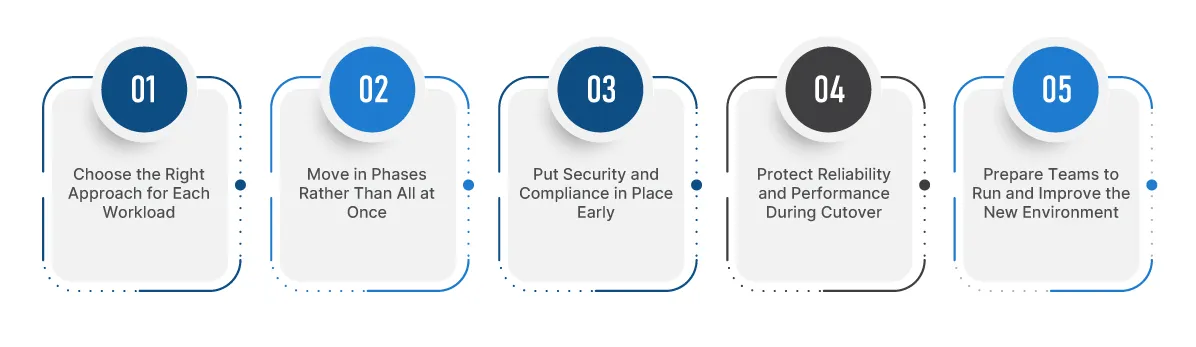
1. Choose the Right Approach for Each Workload
Every application does not need the same treatment. Some systems can be moved as they are to the cloud to reduce data center dependency quickly. Others are better suited to managed databases or container platforms. A smaller set of strategic applications will justify deeper redesign over time.
2. Move in Phases Rather Than All at Once
Migrating in phases is usually safer than a single large cutover. Starting with simpler, lower-risk workloads allows the organization to test tools, patterns, and processes. Lessons from these early moves can then be applied to more complex and critical systems. This reduces disruption, makes problems easier to isolate, and gives stakeholders visible proof of progress.
3. Put Security and Compliance in Place Early
Security, compliance, and data protection should be designed before large volumes of data move to the cloud. Clear rules for identity and access, encryption, logging, monitoring, and data residency are essential. A defined split of responsibilities between the organization and the cloud provider avoids confusion later. Addressing these areas early reduces the risk of gaps, rework, and audit issues.
4. Protect Reliability and Performance During Cutover
The migration should not harm the experience of customers or internal users. New environments need to be tested for performance, availability, and recovery behavior before final cutover. For higher risk moves, there should be a clear rollback option. It helps ensure that systems in the cloud work at least as reliably as before, and ideally better.
5. Prepare Teams to Run and Improve the New Environment
Finally, teams need to be ready to operate in the cloud once the migration starts. They should understand new operational practices, monitoring tools, and deployment methods. Clear ownership of services is important so that someone is responsible for keeping each system healthy and improving it over time. This capability in the teams is what turns a one-time migration into an ongoing source of ROI.
Post-Migration to Turn the Cloud into a High-ROI Engine
After migration, the goal is to make the cloud work harder for the business, not just host existing systems.
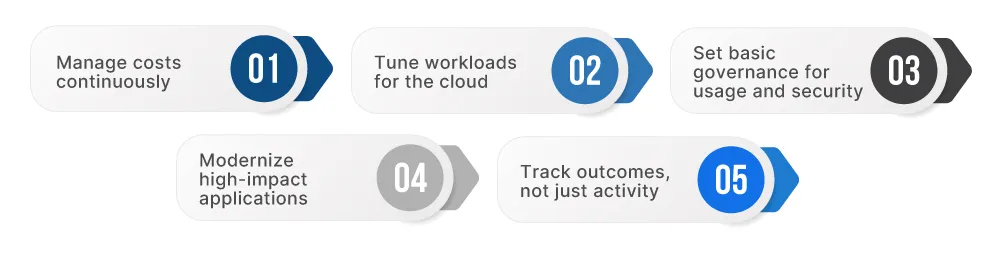
- Manage costs continuously: Review cloud spending regularly. Remove unused resources, clean up old storage, and resize over-provisioned instances. Small, frequent adjustments keep costs under control and protect ROI.
- Tune workloads for the cloud: Do not stop at lift-and-shift. Gradually move suitable workloads to managed services, auto-scaling, containers, or serverless where it makes sense. This improves performance and reduces operational effort.
- Set basic governance for usage and security: Define simple rules for who can create resources, how environments are tagged, and how data and access are handled. This keeps growth under control and avoids unnecessary risk and spending.
- Modernize high-impact applications: Identify a few critical or customer-facing systems and focus on modernization efforts there. Improvements in these areas have a direct effect on revenue, customer experience, and agility.
- Track outcomes, not just activity: Measure uptime, incident trends, deployment speed, time-to-market, and customer experience, along with cloud costs. These indicators show whether the cloud is delivering a real, lasting impact.
Measuring What Matters: KPIs for Lasting Impact
After moving to the cloud, it is important to check if things are better, not just different. A few clear numbers are enough.
1. Reliability
Are systems up more often than before? Track uptime and how often incidents happen. If outages go down, the move will help.
2. Speed of delivery
How quickly can you ship change now? Look at how often you release and how long it takes for a change to reach production. If this is faster and still safe, the cloud is adding value.
3. Cost versus usage
What are you paying for? Do not just look at the total bill. Compare costs with usage, such as cost per transaction or per active customer. This shows if spending is under control.
4. Business and customer impact
Are customers experiencing better service? Watch response times, customer feedback, and time-to-market for new features or products. If these improve, the cloud is helping businesses, not just IT.
Driving Lasting Cloud Impact with TxMinds through Cloud Cost Optimization
Cloud migration is not the finish line. It is the moment when real work begins. The value comes from what happens afterwards: improving how systems run, how teams deliver, and how quickly businesses can respond to new opportunities. When organizations treat migration as the first step rather than the entire goal, the cloud becomes a foundation for better performance, effective cloud cost optimization, faster change, and stronger customer experiences.
TxMinds supports this kind of long-term, outcome-focused journey. Our cloud modernization and migration services helps enterprises move to the cloud with a clear plan, steady execution, and a focus on lasting impact. With experience across AWS, Azure, and Google Cloud, and an emphasis on both modernization and ongoing optimization, we help organizations build cloud environments that are efficient, cost-aware, secure, and ready to grow.


Amar Jamadhiar
VP, Delivery North America
Amar Jamadhiar is the Vice President of Delivery for TxMind's North America region, driving innovation and strategic partnerships. With over 30 years of experience, he has played a key role in forging alliances with UiPath, Tricentis, AccelQ, and others. His expertise helps Tx explore AI, ML, and data engineering advancements.
FAQs
How to maximize cloud ROI?
-
By aligning migration with clear business goals, modernizing workloads beyond lift-and-shift, continuously optimizing costs, and tracking KPIs like uptime, deployment speed, and cost efficiency.
What are the five phases of cloud migration?
-
Assessment and planning, workload discovery and analysis, building the business case, executing phased migration, and post-migration optimization.
What is the ROI of cloud migration?
-
Cloud ROI is the measurable value gained from moving to the cloud, calculated using the formula: (Total Benefits – Total Costs) / Total Costs) × 100%, considering both cost savings and performance, reliability, and speed improvements.
What are the 6 R's of cloud migration?
-
The 6 R’s of cloud migration are: rehost (lift-and-shift), replatform, refactor (or re-architect), repurchase (move to SaaS), retire (decommission), and retain (keep as-is for now).
Discover more